Jessie has been for me, the one Raptor that is the most interesting, challenging, as well as effective Hawk that I have ever trained, or rather- Handled. I qualified that because the word "trained" may not accurately describe Jessie's condition. Enabled may be a better description.
Since the acquisition of such Raptors as Peregrines and Gyrfalcons from the wild has, in the past been impossible, we have had to learn how to interact and train captive bred raptors. This is the most difficult task possible. There are many pitfalls that do not occur with a wild caught Raptor. If you recall the earlier posts concerning Lee-Zard the Prairie Falcon, beginning in May. It was the culmination of many days and nights considering how to traverse the mine field of taking a baby falcon and ending up with a hunting companion that was as minimally mentally scarred as possible. The difficult part is teaching that if you don't kill, you don't eat. Since the "eyass" (meaning baby) raptor thinks you are its mother, it stands to reason that you are the source of food. If it is hungry, it demands that you give it food. After all your its mother, right?
Stripped to its basics, the term, trained Hawk, implies that one has conditioned a raptor to accept a human as a hunting partner. The better falconers have learned how to get a raptor to accept their presence and to be aware that the human will enable them to catch game. Some of this is through repetition and hunger management, with a little Stockholm syndrome thrown in.
http://medical-dictionary.thefreedictionary.com/Stockholm+syndrome
(you may have to copy and paste)
The success of this endeavor can be enhanced by the age that the raptor is taken, but also by the species. Not all raptors are created equal. Some, such as the Coopers Hawk, are wound so tight that it takes little for one of them to go over the edge into total insanity. Some are virtually un-trainable. The key to being able to hunt one of them is to have it so accustomed to your presence that it is totally comfortable in your presence. No easy feat, I might add. In the case of Accipiters, one is much better off not taking an eyass, rather waiting until it is hunting on its own.
Other species naturally seem to be designed for falconry, such as the Peregrine Falcon. The British, who did most of the early notable works on Falconry, valued it above all others. Primarily because they naturally hunt from a height. Thus most of the time being in a position to take advantage of the falconer and his dogs flushing game for them to catch.
This of course is the key factor in hunting with a Hawk- having it being ready and willing to catch what ever the falconer flushes for it, as well being able to recover it when it has done so.
Over the course of my life I have had many Hawks and some Falcons. Having the ability to remember, honestly and without excuses, my actions and the results, has given me a bit of an edge in Falconry. I have drawn some conclusions as to how to find and encourage the behavior that I need in a raptor that I intend to hunt with. Now having spent my life with rather limited means to acquire the "better" strain of raptors, it has taken a bit longer to compile any useful knowledge of the subject. I do not lay claim to being an "expert", it is totally possible that I could be as full of shit as a Christmas Turkey.
I am afraid that this discussion is a bit deeper than I can adequately explain in a short written message such as this, since there are many variables that could influence the discussion. I will do my best however.
The age a raptor is taken from its mother influences the outcome of training almost from day to day. Taken at 19 days old a Peregrine could either become an imprint, or just a dual socialized raptor. In other words it would know that it was a Hawk, but thinks that you might be a distant relative. One taken at 35 days old will be merely an unskilled version of a fully grown Hawk. An imprint can best be described as the little lap dog that will go crazy if you get close to its mistress. Unthinking, and very demanding. Not very pleasant in something with a sharp beak and eight very sharp talons, not to mention very loud vocal chords.
I should add that what I am looking for, is a raptor that knows what it is, and is comfortable enough with its life that it neither fears nor disrespects you. It does not long for freedom, or is dissatisfied with its life. With that accomplishment the only limiting factor is its innate ability to catch game and yours to present the game. That stage for a Peregrine is about 28 days old. In Prairie Falcons the age would be 22 days. Gyrs and Hybrids would be about 38 days old.
The way to achieve this level is through the age that it is taken. Too early and it is an imprint. Too late and the feathers can suffer through shock marks, ( a weakening of the feather shaft due to the withdrawal of the blood that feeds them. Occurring through the shock and fear brought on by handling)
It is only when you have accomplished such as described above that you see the bird for what it actually is. A raptor that is uncomfortable around you, will not show you its true self. It will always hold back, or be reserved in its reaction with you. In many ways you can get away with some mishandling of an older bird, that you could not with one taken at the time that I describe.
In Accipiters such as Goshawks, Coopers and Sharpshins, none of this is needed. Falcons can benefit, having descended from totally different stock they have different reactions and thinking processes. Plus they are readily available in the wild, there is no need to jump through unnecessary hoops, although some will continue to do it.
I have mentioned many times that Jessie is a character. She can be described that way because she has reached a level that she is totally acclimated to her life with me. She unfortunately treats me the way that she would a mate. She is totally trustworthy in the field. I don't have to look for her when I go to flush. She will be there. She however does not like to spend the nights outside, preferring the comfort and safety of her night perch in my shop. If she thinks that I have treated her unfairly she will not hesitate to attack me with beak and claw. She has so far laid about 38 eggs unsolicited or fertilized, by me.
For the most part she is a hard working, very determined hunting falcon. She will, as long as there is game take a pitch over Ducks as many times as is necessary to kill one. She will fly as long as she can, rest on a hill side when she needs to. Regaining her pitch when she has rested. She has killed three Geese, Sage Grouse and even attempted to take a Swan. She was lost when we first moved to Jordan for three days. She chewed her leash off and flew off with a swivel connecting her legs. Three days later she returned to the house and when I picked her up she had a full crop.
All of that makes her sound pretty good. In fact she is but like over achievers everywhere, she demands a price. If I am clumsy when she has killed a Duck, and show too much eagerness to secure her to my glove she will get pissed and stay pissed until the next time and I do better. She has attacked me three different times, because of my insecurity with caught game. If I wear a different hat than the one that she is used to, she calls alarm and won't let me touch her. If I get impatient and do not wait for her to step on the fist when I am moving her from her inside to her outside perch, she will bate from the fist and be cranky for at least a week. She has a well developed sense of dignity, and I had best treat her in accordance.
At this time of the year the raptors in my care spend the days in the weathering area, and the nights on their perch in the shop. This allows me to maintain a working contact with them, and in the case of Hope, the Harris Hawk, allows me to feed her without the counterproductive aspect of "tossing her food". I put their food on their outside perch and take them to it. This keeps Hope from making the connection of hands always having food in them. Harris Hawks are too smart and will sometimes get aggressive. It is best to not let that happen.
Since they are both molting, and the molt is triggered both by the time of the year and the amount of food, or their weight. Control is a fine line. Too much weight and the bird doesn't want to be bothered, and too little, the molt suffers.
Hope is not a problem. I stick my fist out and tell her to "get on" and she eventually will. The hungrier she is the more willing she is. If either bird will not get on, they don't go outside. Hope almost always will, but only takes one day without food to ensure that she is cooperative. Jessie is another matter. The key is to keep them as heavy as I can and still obtain cooperation.
Jessie's indicators that she is getting too heavy is, when I step outside the shop, she will bate off the fist. Once and she is close to too heavy. Twice and she is for sure too heavy. I then normally do not feed her the next day. She however has a tendency to try to set me up for failure. Now I do not ascribe to the Disney school of thought that critters think and reason as we do. With Jessie I would call it more think and un-reason. That is because we don't think the same. 2+2= 14 for her. In other words, most of us are too stupid to see the result of her thinking. Simplified, Raptors think in terms of strength. If I am strong enough, I will take what you have, and maybe your life. Paranoia is merely an advanced sense of reality. So no matter how many times you give your bird its meal, it still thinks that it stole it from you and you are only waiting for the chance to take it back.
Jessie, yesterday when I went to pick her up, looked at the fist, then looked up at me, as if to say NO! What are you going to do about it? Normally I pick up her jesses, put my fist on her perch and give the command, she will step on, softly talking to me. We then go outside, I tie her to her slider, set her on the tire and she will then fly to her perch and start eating her food.
If I get pushy and nudge her with my fist, she gets cranky. She will generally get on, but she is simmering with dignified outrage, that will soon come out as anger. The worst thing I can do is to scoop her up with her jesses. That comes with vocal outrage and eventual rebellion. So in the last few years, I have decided to take my cues from her. She is a bit like pushing a chain. You can try, but the result is generally messy.
The part that I find amusing is that you can see the gears turning in her little devious head. So anyway, yesterday she would not get on the fist. I stood there for a bit, even repeating the command. Nope! she would look at me, then look at the fist and stand stock still. I turned and left the room. Since the weather was good enough that I had gone out earlier than usual, I marked it up to that. You see, she is very conscious of time as well. 10 AM is the usual time, and 10 AM is when it should happen. I am not kidding! So I waited until 10 AM and went back out. It only took one look at her to know that she wasn't going to cooperate. At this point I was enjoying the contest of wills. I made the offer any way and of course she refused just as before. I left her there all day, and didn't approach her again.
This morning I went out, picked up Hope, and put her on her perch, but did not supply any food to her today. A bit too heavy after about 8 oz of Rabbit back strap yesterday. I approached Jessie and I could again see the rebellion in her stance. I offered, she refused, I walked away. I left her until we went out to exercise, and offered again. She looked at the fist, then at me, at this time it was OK to bump her legs a bit. She stepped on confident that she had made her point. She was a perfect lady while I tied her to her slider. She then went to eat her meal. The consequences are not so bad if we are not hunting. If we were hunting, she would have ignored the flush or just whiffed it, if I had offended her.
She will be a little angel for a while, then soon in the near future she will again set her trap to see if I still respect her.
Its too bad that Jessie came so late in my life with her lessons. I'm not sure if I have time enough to start another. Hawks are, basically simplified, better their first year than the second. While a Falcon will take as much as three years to develop a winning strategy that can be counted on each time.
Jessie seems to have recovered from whatever state of mind or malady that affected her the last two years, so I will take her up to hunt again this year. I can hardly wait.
Friday, March 3, 2017
Wednesday, March 1, 2017
shopping
Things have been a bit slow due to the weather. We are beginning to get some neat Sunrises again and I am including some of the better shots. The shots are of the sunrise as it develope's.
We had a bit of moisture that morning so the rainbow was a bonus.
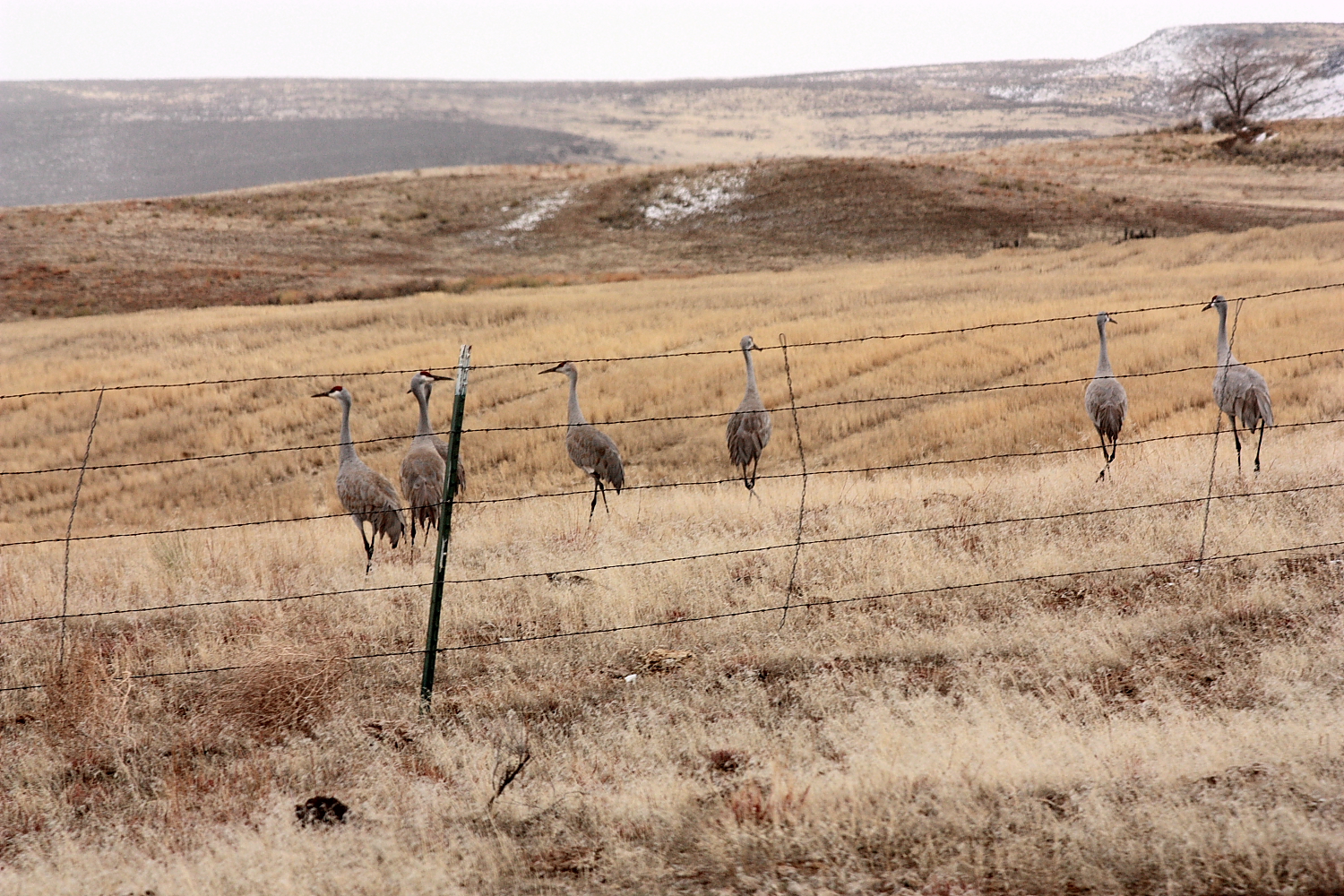
We also made the last Raptor count of the year and noticed that the Sandhill Cranes are in.
We are still having some storms and snow, but it is melting off again. A bit further South at a friends ranch off the Whitehorse road the snow storm dropped 10.5 inches of snow on them. With all the snow the Rabbits are swarming as well as the Deer herds. I supplied him with a Pigeon trap and he wanted one for Starlings as well. Today we both had the time to fix up a trap, and I decided to take some of his Rabbits off his hands.
On the way down there I saw two bunches of feral Horses, and a small group of Antelope. I was told that the last time he went out to the Hwy he saw about 500 Antelope along the Whitehorse road. The snow has really been hard on the Antelope this year.
As I drove into his place I looked at his stack yard and the rabbits were thick, so I pulled in and stopped, rolled my windows down and started picking them off. I only took head shots, so that I can cut that part off and discard it therefore removing the danger of lead poisoning for the Hawks. I shot 20 before the yard was empty of live rabbits. Only three escaped alive.
Richard came out and I scattered the Jacks out in the snow to cool and get finished leaking. We went to the pigeon trap and got five out of it. Richard gave me the other 13 that he had frozen. We built two Starling traps and got them set and ready, then retired for coffee and some "Bull shipping."
When I left to go home, I killed another five rabbits that had come in to the stack yard. Not a bad day at all. Richard has a real problem with the Jacks. They undermine the hay bales up about 12 inches. Left long enough the 500 lb. bales will tumble making a mess.
As I was coming home, the sun was setting behind the Steen's. Not a bad day. I ended up with 25 Jacks and 18 Pigeons.
Tuesday, February 7, 2017
Still having fun!
Sunrise
South Mountain, 60 miles East in Idaho
I am not really complaining, just blown away by what has turned out to be the most intense winter for this area in at least 30 years. Having said that, I must tell you that what we have gotten is nothing compared to what is happening in other parts of the North West. Granted it has been a little inconvenient, but no where near as serious as it has been all around us. Those poor guys are suffering collapsed roofs, warehouses, and now of course flooding due to the naturally rapid melting.
The wildlife is suffering the most. The Antelope, Deer and Elk, not to mention the Game birds are catching hell. The Elk have come out of the high country for the first time that I have witnessed. Of course I have only been here 11 years. A friend told me during a phone call that the Elk had come into the towns at the foot of the Cascades, where I used to work. Of course along with them came the Cougars. One of the little towns that I spent many nights while working for the RR had killed 6 Cougars so far. Of course the Dogs and Cats made a much easier food source than Elk.
What affected us the most was the ice. The ground does not willingly accept water here, so as it melted, it stayed on top of the ground, and then naturally it froze into an uneven sheet of ice. "Normally" this time of the year is fairly warm, while the last of Dec and most of Jan are bitterly cold, ( for us anyway) with the temps in the minus range. The temps have risen to 46 the last few days and the ice was finally receding. That of course means that the creek fills up. Not a problem for us, but the melting on the hill between us and the Hwy drains almost all of the water right onto the flat where the house is located.
This time I was ready. I dug a trench along the uphill side of the house and when the water came up, I set up the sump pump, and moved the water on down the hill to the Creek. Year before last I took a road grader from next door and cut drainage ditches across the hillside to divert the water draining off the hill side, and then cut a trench in the "ranch" yard parking spot to divert the remaining flow around the house.
Things were looking up, and then this morning when I got up there was a brand new very wet 4 inches of new snow on the ground again. Now at noon the Sun has come out.
Tuesday, January 24, 2017
Clarification
I seem to have forgotten that everyone who receives this blog is not a falconer, and rather than provide answers as to why I am stopping hunting at this time, I have merely raised confusing questions.
A friend asked why I couldn't hunt during the molt, since hawks in the wild have to eat, why does Hope have to stop hunting? Here is the answer.
A human that is starved, or if you would prefer, deprived of food, loses weight by feeding on its fat cells, and if carried far enough, its muscle tissue. In a human it takes weeks for that to occur. In a Raptor it can be less than a 24 hour period. In a Harris Hawk about 48 hours. The food or its carrier, the blood, is withdrawn from its extremities, in the raptors case the blood in the growing feathers. This also creates a "hunger Streak". The result is the same whether it is from Shock or food deprivation.
A feather that is growing is filled with blood. If that flow is interrupted then the feather grows out with a "shock mark" all across it. It is therefore weakened and will break at that point under any serious stress. Of course a raptor with damaged feathers loses aerodynamics and ability to maneuver.
A raptor in the wild will carry at least 10 percent more body weight than one in captivity. A fat bird, (one in the wild) is basically either too lazy, or unwilling, to seriously pursue to the extent that it is able to catch prey. That same bird in captivity at that same weight is also the one that will go sight seeing or sit on a pole and reduce the falconer to begging and unrealistic promises to get it to return to the fist.
Now granted Hope was way more than willing to overlook the hunger requirements, and I could most likely keep her growing feathers from the flaws that could come from not enough food. I doubt that the same could be said for the more active and faster metabolism raptors.
As of this time Hope is most likely in the 1200 gram weight range. She is heavy enough that she wheezes much like I do just from the fat packed on her body. She has just now dropped her first feather. I went out to pick her up this morning to put her out in the weathering area. I offered her the heart and lungs of a rabbit that she had killed and she refused to step on the fist. :-) Then when I forced her to step up, she showed no interest in the food.
The molt is triggered by two things, sunlight, or length of the day, and a comfortable weight cushion. Hope has just reached both the levels so that a molt has been triggered.
The other thing that perhaps I need to clarify concerns my statement concerning Jack Rabbits coming into the breeding season, and my unwillingness to hunt them at this time. I like to think and do believe that falconers have developed a bit higher level of a code of ethics than most hunters. I know that one of the things that I try to instill in any novice, that I sponsor in Falconry, is a reverence for the quarry and the raptors that we work with. The only time that I try to stack the odds in my hawks favor is for the one that is just starting. Once they are made to game it is an insult both to the prey and the raptor to choose a situation that the prey has no opportunity to escape. A flight that the Duck or Jack is able to escape is valued just as much as the one that the Hawk won.
A falconer that I know questioned why I did not continue hunting right on through the breeding season for Rabbits, since they were so common and in some species, an introduced species. My explanation to him is about as good as I could do, so I have copied my letter to him. While I do not harbor any belief that I am right and he is wrong, It is just not right for me.
Be well!
A friend asked why I couldn't hunt during the molt, since hawks in the wild have to eat, why does Hope have to stop hunting? Here is the answer.
A human that is starved, or if you would prefer, deprived of food, loses weight by feeding on its fat cells, and if carried far enough, its muscle tissue. In a human it takes weeks for that to occur. In a Raptor it can be less than a 24 hour period. In a Harris Hawk about 48 hours. The food or its carrier, the blood, is withdrawn from its extremities, in the raptors case the blood in the growing feathers. This also creates a "hunger Streak". The result is the same whether it is from Shock or food deprivation.
A feather that is growing is filled with blood. If that flow is interrupted then the feather grows out with a "shock mark" all across it. It is therefore weakened and will break at that point under any serious stress. Of course a raptor with damaged feathers loses aerodynamics and ability to maneuver.
A raptor in the wild will carry at least 10 percent more body weight than one in captivity. A fat bird, (one in the wild) is basically either too lazy, or unwilling, to seriously pursue to the extent that it is able to catch prey. That same bird in captivity at that same weight is also the one that will go sight seeing or sit on a pole and reduce the falconer to begging and unrealistic promises to get it to return to the fist.
Now granted Hope was way more than willing to overlook the hunger requirements, and I could most likely keep her growing feathers from the flaws that could come from not enough food. I doubt that the same could be said for the more active and faster metabolism raptors.
As of this time Hope is most likely in the 1200 gram weight range. She is heavy enough that she wheezes much like I do just from the fat packed on her body. She has just now dropped her first feather. I went out to pick her up this morning to put her out in the weathering area. I offered her the heart and lungs of a rabbit that she had killed and she refused to step on the fist. :-) Then when I forced her to step up, she showed no interest in the food.
The molt is triggered by two things, sunlight, or length of the day, and a comfortable weight cushion. Hope has just reached both the levels so that a molt has been triggered.
The other thing that perhaps I need to clarify concerns my statement concerning Jack Rabbits coming into the breeding season, and my unwillingness to hunt them at this time. I like to think and do believe that falconers have developed a bit higher level of a code of ethics than most hunters. I know that one of the things that I try to instill in any novice, that I sponsor in Falconry, is a reverence for the quarry and the raptors that we work with. The only time that I try to stack the odds in my hawks favor is for the one that is just starting. Once they are made to game it is an insult both to the prey and the raptor to choose a situation that the prey has no opportunity to escape. A flight that the Duck or Jack is able to escape is valued just as much as the one that the Hawk won.
A falconer that I know questioned why I did not continue hunting right on through the breeding season for Rabbits, since they were so common and in some species, an introduced species. My explanation to him is about as good as I could do, so I have copied my letter to him. While I do not harbor any belief that I am right and he is wrong, It is just not right for me.
As for the prey species, I suppose that we will just have to disagree. While scientifically I suppose that my draw on the wild species of Jacks will not make any more inroads on the situation than is covered in the wild. All excesses will be drawn off by nature, and it is unlikely that my efforts will be even noticed by any one, or thing, other than myself.
I suppose that my main objection to hunting at times of maximum vulnerability is more of a principal than reality. I just don't need it and actually my goal is not a headcount, but a raptor than can out perform its best opposition.
My up bringing was by a man who revered wildlife, and was a superb hunter. Through the efforts of his and my mothers hunting ability we were able to eat and eat well. I never had beef that wasn't on a hamburger bun before I was 19 years old. I was taught to revere wildlife, and to waste nothing. I consume one way or another every thing that I kill, and am very grateful for the wildlife and dedicated to maintaining a healthy population so that I can continue to have some, available to kill when I need it next. My parents instilled in me a reverence for all life whether it is a Rabbit or a human. It is perhaps a "romantic notion", but to me it is a matter of ethics, both for the sport, and the way I live.
I do know, and have witnessed, that excessive hunting pressure can effect the amount of wildlife in an area. Are either you or I likely to attain that level of pressure? Certainly not with Hawks.
Be well!
Monday, January 23, 2017
Winter keeps hanging on, Now its too late.
I have been waiting and hoping that the weather would moderate so that I could get out to do a bit more hunting. Its just not to be. We still have several inches of snow and ice on the ground. Even if the weather turned nice enough to expose her to it, the ground either has to freeze or dry up enough that you could travel over it to get to a hawking spot, much less be able to walk on it.
The ground here is most likely different from any thing that you would know or experience. It is not used to much moisture at all. Most of the water runs off and if it ever gets soaked in, there is little bottom to it. I would have to stay on pavement or heavily graveled dirt roads if I didn't want to tear the roads up. Even if the weather cooperated it would take at least two or three weeks before I could safely get out into the back country. The Jacks will be in the middle of the breeding season by the end of Feb. Its time to except reality and give it up.
I also have another incentive to quit. When I went out to pick Hope up from her day perch I found this. A nice secondary was lying by her perch. Ah well, there is always next year. I had been cutting her back a bit, but not soon enough.We will try for a clean Molt, and plan to be ready about the middle of August.
If you recall early in the season she pulled the sheath off her little toe. There was some question of whether or not it would grow back. The answer is no!
All the areas around us are buried in snow. I think there is about 3 feet on the flat at Burns, for sure in Vale and Ontario, both about 100 miles North. It will make for a good water year, and they will probably be able to raft the Owyhee until the middle of June.
We escaped the wrath of Obama and still have our land. I guess he was too busy trying to screw Trump up to mess with us. Perhaps it was the hornets nest that he stirred up over the Bears Ears in Utah and the enlargement of another National Monument in the Oregon Siskiyou's. Whatever, I am just glad that he didn't screw this area up.
Things will quite likely be a little quieter here until the weather gets good enough to do some flying of the mechanical sort at least.
Sunday, January 15, 2017
Conclusions to earlier supposition concerning Owls
This is my second post for the day. I guess I should have waited. Patience has never been any of the things that I am good at, so a follow up is necessary.
There are four nest boxes across and four deep. They measure 12x12X12.
I admit that the study of Owls by me has been merely accidental. I am quite sure that if there was a measurement, I would fall somewhere close to ignorance of the subject. My knowledge has come from mostly incidental and bad experiences. That has also mostly concerned Horned Owls. Horned Owls are a real pain. They have a tendency to try to eliminate any and all possible competition for Prey species. If that happens to be a semen donor Peregrine, Or a perched Goshawk, tough luck.
Great Horned Owls will kill every Pigeon that moves or makes its self known in a Pigeon house. They will kill a full grown Chicken and eat only the head. They regularly kill house Cats that are not cautious enough to avoid them.
Barn Owls however are generally known as the good guys. They eat a tremendous number of Mice and Rats each night. Apparently they are quite capable of adjusting to extreme conditions when necessary. I think you will recall that I was telling you that the weather here was putting the wildlife in danger. A danger that they are not used to, since the weather this year is a lot colder and snow many times deeper and longer lasting than is usual. This "global warming" is kicking our butts for sure.
The snow is heavily crusted now and there is no reason for a Mouse or Vole to ever have to come to the surface. The Harriers compensate by turning their hunting pressure on the Quail, and they are relentless. Apparently the Barn Owls are turning to other food sources as well.
I mentioned the reasons that I didn't think my predator on the Chickens and Pigeons was a Great Horned Owl. It appears that it has been this little guy at the top of the page. The Chickens that I have been losing have all been Old English which is about the size of a big Pigeon. My confusion came because if it had been a GHO it would have been a slaughter. This was precision.
I found the Owl this morning and he was sitting where he was in the picture above. I decided to leave him in there and release him this evening. I went out at dusk to do just that and he was not where I had left him. I looked better and found him to be in one of the nest boxes trying to eat a frozen Squab. That explains the cache's that I noticed earlier. I opened the Door expecting him to bolt out to freedom. Nothing happened! I looked harder and could see his back in one of the nest boxes. I had to go in and pat the side of the box to get him to leave.
I had been dropping a solid door down in front of the Pigeon access each night. When I would let them out the next morning I had apparently been locking a predatory Owl in with them a lot of the nights. He would have just sit quietly in one of the corners or nest boxes with his back to the door where he would not be seen. Normally I would not have opened the big door at all.
Life just got tougher for him, the Buffet is now closed. There are no more Pigeons and the Chickens are under wire.
Jan 14th, 2017
The days and nights are still cold as can be. We are currently in a recurring fog situation. I was surprised to see that the humidity was 84 percent this morning. Summer time is generally under 17 percent.
This time last year the temps were in the high 40's. It is warming up but slowly. We still have a lot of ice and snow and the temperature this morning was 3 degrees. It will pass and fairly soon if things are any where near normal. However normal keeps changing.
I did find the weight that Hope no longer feels that she needs to step up on my fist, or let me pick her up when she does get to go out to her perch. I had a couple of days that I could put the birds outside, and Hope forced me to scoop her up by her leash. I decided that was not what I wanted so I put her on the scales. Apparently 1265 was just a bit too high. Keep in mind that when I got her she weighed 874. There was nothing wrong with her manners, she just didn't want to come to me. She still went on a reduced food plan however.
I have made a few changes since I last posted. The Chickens began to try to roost in the wood shed due to the depredations of a Horned Owl. Apparently he was coming in during the reduced light conditions with the snow and cloudy days. I relocated him as soon as I discovered what was happening, but the Chickens, lead by their Rooster were still trying to stay out. I have decided that I prefer the eggs from the Old English hens to regular Chickens, so I gathered up two of the Old English Roosters, and all of the surviving hens no matter the breed and locked them up in the enclosed Chicken pen. The rest of the Roosters ( about 7 ) I left locked in the other pen. As soon as the weather permits they will be cleaned and put in the freezer. This includes the Rooster that lead the rebellion.
About 12 of the Pigeons also were sleeping out. I examined the possible uses of Pigeons and realized that the only use they have is for food for the Hawks. I no longer trap, and I have never used them to train my Hawks, so there was really no reason the even have them. I had been closing their "trap" door at night, but I soon discovered that something had been going in there killing and eating what it wanted and leaving again through the pigeon trap door. I end up feeding about 100 pounds of pigeon food a month, and only getting what surplus Pigeons that I can keep from the Raccoons , Horned Owls, and the Prairie falcon that cannot resist them. I decided it was not worth it, so I closed the trap and quit feeding outside. It only took a day for them to go into the house for the food there. I put 18 Pigeons in the freezer for the Hawks. I also left the trap down to perhaps see what was going in there.
Imagine my surprise when I found this fellow in there this morning. I cannot say for sure that "he" has been going in there and dining in leisure or not, but it is suspicious. There were parts of bodies that were obviously been eaten by a Raptor, as well as uneaten parts stashed in a corner. Horned Owls do not operate that way. They kill every thing they can and generally eat only heads after the main hunger has been satisfied, and they are not smart enough to exit a small hole in an other wise wall of screen. So I am reasonably sure that a Horned Owl was not the culprit.
The Quail were the most hurt by the Chickens and the Pigeons being locked up, and they were scrambling to make up the outside Chicken food loss.
So I will continue to put food out for them as long as the weather stays bad. We probably have a flock of 60 to 100 here on the creek. Apparently they make up a rather large portion of the food supply for the Harriers that hunt and live here.
I noticed a Prairie Falcon hanging around waiting for the Pigeons to come out to play today as well. I am not sure that she has ever been what you would call successful on a regular basis, but she seems more than willing to try.
The weather has to moderate soon, and I can hardly wait.
Subscribe to:
Posts (Atom)